Two instruments published together set every member state’s binding annual carbon budget through 2030: one for land and forests, one for transport, buildings, and agriculture. The LULUCF table makes visible something Germany has long preferred to discuss quietly: its land sector has shifted from a carbon sink into a net source.
Two measures published simultaneously on 27 April 2026 complete the binding national climate target framework for the period running up to 2030. Together they define for every EU member state how much carbon it may emit, and how much its land and forests must absorb, in each year through the decade’s end.
The first, Regulation 2026/893, sets annual limit values under the LULUCF Regulation (EU) 2018/841, which governs greenhouse gas emissions and removals from land use, land use change, and forestry. These are not caps on emissions but floors on carbon absorption, so member states must ensure that their managed land removes at least as much carbon as the annual limit specifies. The values, running from 2026 to 2029, are derived from a comprehensive review the Commission and European Environment Agency conducted in 2025 of national greenhouse gas inventory data for the years 2016 to 2023.
The second, Decision 2026/895, sets annual emission allocations under the Effort Sharing Regulation (EU) 2018/842, which covers the sectors outside the EU Emissions Trading System, such as road transport, buildings, agriculture, waste, and small industry. These allocations decline each year, tracking a linear trajectory toward each member state’s 2030 target. Both instruments are binding and directly applicable.
One notable insight from the LULUCF table is that Germany’s annual limit value for 2026 stands at positive 39.4 million tonnes of CO₂ equivalent, meaning its land sector must emit no more than that, and therefore its forests are not expected to absorb any CO2. In practice this records a net emission, not a net removal, which is something that is not expected for land devoted to forestry. Denmark is similarly on the emissions side of the ledger. By contrast, Sweden carries a target absorption of 41.9 million tonnes, Poland 39.2 million, Romania 44.9 million, and France 48.5 million.
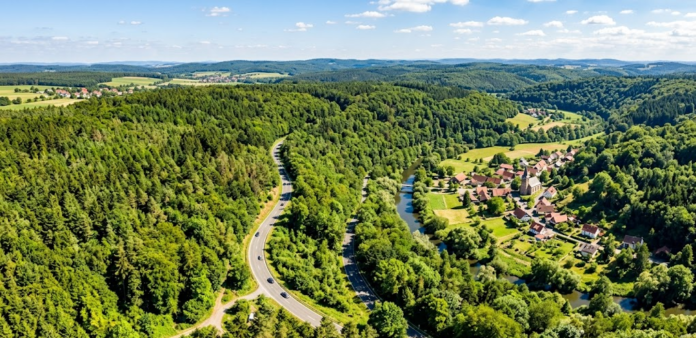
The story behind Germany’s figures is well-documented, as the country’s forests, which for decades functioned as a reliable carbon sink, have been severely degraded by a combination of bark beetle infestations, sustained drought since 2018, and storm damage. This has caused a crisis-level of damage to german forests, as dead and dying trees release stored carbon rather than sequestering it. The LULUCF regulation’s revised methodology, applied to the 2025 inventory review, has taken these numbers into account, now formalising the effects of this crisis and passing them onto a legally binding annual figure.
Under the Effort Sharing Regulation, the allocations decline annually on a preset trajectory toward a fixed 2030 endpoint, with the 2026 to 2030 values adjusted to reflect the most recent national inventory data. The largest absolute allocations, as expected, go to Germany (338.8 million tonnes in 2026), France (277.1 million), Spain (178.4 million), and Poland (184.8 million), reflecting both their population and economic size. All member states see their allocations decrease each year, with Germany’s allocation will reduced to 242.4 million tonnes by 2030.
Member states that cannot meet their LULUCF annual limit values face compliance costs and must either purchase flexibilities from other member states or implement additional land management measures. For Germany, which is also under pressure on its Effort Sharing trajectory given the slow decarbonisation of its buildings and transport sectors, the land sector problem compounds rather than offsets. The 2032 compliance check will determine whether these targets were met. The 2026 to 2029 values published today are the annual waypoints toward that assessment.
