A single pan-European company form, incorporable in 48 hours for just €100, alongside standarised capital rules, SAFE-compatible financing, and an end to the stock option tax chaos are at the core of the EU’s bet to match the flexibility of Delaware.
The twelve-country founder
Imagine a three-person team, building a startup on a digital product. One, is a German engineer, who writes the code. Then, a Spanish designer runs the product. Finally, a French lawyer handles the legal compliance issues. Now, imagine that they raise a pre-seed ticket from an angel in Milan, open a sales office in Amsterdam, and hire their first five employees out of Lisbon, Warsaw, Tallinn, Dublin and Copenhagen. A Dutch fund leads the seed round eight months in, and later, a U.S. venture firm wants to join the Series A.
On paper, they are building in the world’s largest integrated market, encompassing 450 million consumers, with a single currency across most of it, and the legal doctrine of freedom of establishment written into the Treaty. In practice, however, almost nothing about their company was designed for any of this.
They will pick a country to incorporate in, and immediately inherit one of twenty-seven different notarial regimes, capital requirements, share-transfer rules, board-meeting formalities, and stock-option tax regimes. Their Spanish designer will not get options on the same terms as the German engineer, because the tax moments differ. The Milan angel will sign on paper. The U.S. lead investor will insist on flipping the cap table to a Delaware holding company because a SAFE has never been tested under Finnish law. Half the investor’s due-diligence bill will be spent mapping the unfamiliar corporate structure onto a U.S. model that fund accountants recognise.
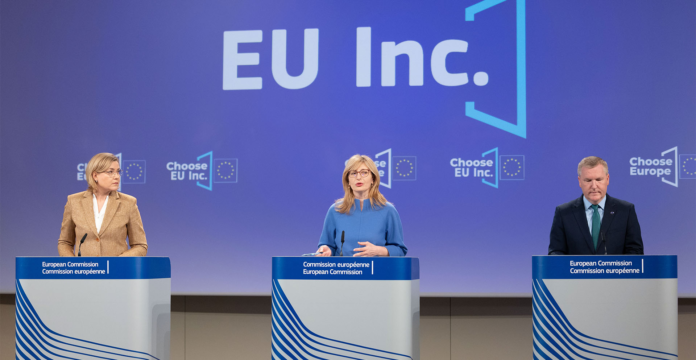
This is the problem that the European Commission’s proposal of 18 March 2026, informally known as”EU Inc.”, was written to solve. It is arguably the most ambitious company-law project Brussels has launched in four decades, and it lands at a moment when the EU’s own reports tell it that competitiveness, not regulation, is now the union’s central political task.
What is the “28th Regime”?
Start with the name. Europe already has twenty-seven national limited-liability forms, such as the Société à Responsabilité Limitée in France, the Gesellschaft mit beschränkter Haftung in Germany, the Sociedad de Responsabilidad Limitada in Spain, and so on. The Commission’s proposal does not abolish them, harmonise them, or preempt them. It adds a twenty-eighth option, available optionally and in parallel in every Member State, with a single EU-wide brand: EU Inc.
Mechanically, the proposal takes the form of a directly applicable Regulation (so it enters the law of every Member State simultaneously on the day it applies, without transposition) under Article 114 TFEU, the internal-market legal base. Every Member State must introduce EU Inc. into its own company-law statute book. A company incorporated as an EU Inc. in, say, Portugal, is governed primarily by the Regulation itself and by its articles of association; Portuguese company law fills in only where the Regulation is silent. The Portuguese business register issues the company’s legal personality and its European Unique Identifier (EUID). All the other Member States must then recognise that legal personality automatically.
Premium Users Only
The effect is simple to describe but quite unusual to achieve: a company that is one legal form with twenty-seven registered offices, governed by a core of pan-European rules that do not vary by country, bolted onto a digital infrastructure that already exists (the Business Registers Interconnection System, BRIS) and a digital identity stack that is being rolled out anyway (the eIDAS framework and the forthcoming European Business Wallet).
The target audience is narrower than the legal form’s availability. The Commission openly describes the EU Inc. as a framework designed “in particular for the needs of startups and scaleups”, even though any founder, be it a natural or legal person, may use it for any lawful purpose. The explanatory memorandum is clear that this is an attempt to fix, specifically, the friction that growth-oriented companies experience when they try to operate across borders.
€328–440M
Admin savings
Cumulative reduction in administrative burden for EU Inc. companies over 10 years.
308,000
EU Inc. companies
Estimated number of companies expected to adopt the 28th regime over the first decade.
48h
Fast-track formation
Maximum deadline for incorporation through the EU central interface with the standardised template.
€100
Cost ceiling
Maximum fee for the entire fast-track incorporation, including preventive legal control.
€0
Minimum capital
No paid-in share capital required at incorporation — creditors are protected by balance-sheet and solvency tests.
27
National legal orders
Every Member State must introduce EU Inc. as a new legal form in its own company law.
1,467
Consultation replies
96% of the company responses came from SMEs; 80% of total replies came from EU citizens, mainly founders and investors.
€1,780–2,850
Saved per share transfer
Estimated saving on a growth-stage secondary transfer of €500,000, thanks to fully digital procedures and no mandatory notary.
~€1,100
Saved per financing round
Expected reduction in legal and administrative costs per round thanks to harmonised capital-raising procedures.
€2.7M
One-off IT cost, all 27 MS
Total estimated adjustment cost for Member States to connect national business registers to the new EU central interface.
~3mo.
Fast-track liquidation
Duration for removing a solvent EU Inc. with no pending claims from the business register.
6mo.
Simplified winding-up
Deadline for concluding insolvency proceedings of an innovative-startup EU Inc., using electronic auctions for asset realisation.
Where the proposal comes from
EU Inc. did not arrive unannounced. As a matter of fact, it is the convergence point of three distinct political streams, each of which produced a landmark document between April 2024 and May 2025:
- The Letta report (“Much More Than a Market”, April 2024), commissioned by the European Council, argued that the Single Market was still structurally fragmented in the areas most important to innovation, namely finance, telecoms and energy, and called specifically for a “Simplified European Company” as one of the concrete tools needed to finish the job. This was the first time a senior-level EU document named the problem this proposal tries to solve: that startups face twenty-seven different corporate-law learning curves when they try to scale across the continent.
- The Draghi report on EU competitiveness (September 2024) sharpened the diagnosis into a political warning. Draghi’s central claim, that the EU is falling behind both the United States and China on productivity growth, research commercialisation, and capital formation, was accompanied by a call for a new EU-wide legal statute for innovative startups, which he labelled an “Innovative European Company”. The Draghi diagnosis has since become the organising principle of the second von der Leyen Commission.
- The 2025 Commission strategies translated those two reports into work programmes. The Competitiveness Compass of 29 January 2025 formally announced a 28th regime as part of a broader competitiveness package. Four months later, on 21 May 2025, the Commission communication on the Single Market (“our European home market in an uncertain world”) confirmed that the 28th regime would be built on digital-by-default solutions. A week after that, the EU Startup and Scaleup Strategy “Choose Europe to start and scale” (28 May 2025) turned EU Inc. from a slogan into a project.
On 20 January 2026, the European Parliament adopted an own-initiative resolution on the 28th regime, a highly unusual step, because own-initiative resolutions under Article 225 TFEU are Parliament’s formal way of asking the Commission to legislate on a specified topic. Among other things, the Parliament called for simplified formation and registration, measures to facilitate employee stock ownership, stronger dispute-resolution mechanisms, and safeguards to protect employee participation rights. The Commission’s proposal, published on 18 March 2026, follows that resolution point by point.
The stakeholder evidence base sits underneath all of this. A public consultation held across 2025 drew 1,467 replies, of which 80% came from EU citizens, predominantly founders and investors, and a further slice from legal professionals, SMEs, trade unions and Member States. 96% of the companies that responded were SMEs. A parallel call for evidence drew another 879 replies. The European Economic and Social Committee published a dedicated own-initiative study in support of the framework. The Commission’s own Informal Expert Group on Company Law (ICLEG), composed of sixteen academics and practitioners from twelve Member States and EFTA countries, was consulted in depth. The Regulatory Scrutiny Board gave a positive opinion on 13 February 2026.
The political ownership of the file is unusually concentrated, as Commissioner Michael McGrath (Justice, Democracy, Rule of Law and Consumer Protection) has carried the file through the High-level Forum on Justice for Growth, while the Danish Presidency used its September 2025 Council Working Party on company law to run a structured exchange on the topic among Member States.
The Path to a Continental Company
The regulation is built around the belief that, if the corporate rules look the same everywhere, and if the paperwork is routed through an EU-level digital front door, then the cost of doing business across borders will collapse far enough to change founders’ and investors’ behaviour. It implements that bet across the full corporate lifecycle, from incorporation to closure.
Formation
Incorporate in 48 h, for €100
- Fast-track via the EU central interface on BRIS, using harmonised bilingual templates.
- Signing with the EU Digital Identity Wallet (eIDAS).
- Once-only data transfer to tax, VAT, social security and beneficial-ownership registers.
- Allocation of a European Unique Identifier (EUID).
Chapter II — Articles 13–22
Operation
Digital-by-default governance
- Directors (at least one EU-resident) subject to a harmonised duty set and the business-judgment rule.
- Fully online general meetings and board meetings.
- Bilingual articles of association; EU Company Certificate and digital EU power of attorney for cross-border dealings.
- Cross-border branches set up through the same central interface.
Chapters III–V
Financing
Raise capital without friction
- Dematerialised shares in a digital register; free transferability unless articles restrict.
- No par value by default — down rounds and dynamic pricing become lawful.
- Explicit support for SAFEs, KISS notes, warrants, convertibles and multi-voting classes.
- Balance-sheet and solvency tests replace capital maintenance as creditor protection.
Chapters VI–VII
Talent & scaling
EU-ESO and market access
- EU-ESO warrant-based employee stock option plan with a minimum vesting period.
- Taxation only at disposal of the shares — no dry tax charges at grant or exercise.
- Admission to SME Growth Markets and other MTFs without legal conversion.
- Member States may open regulated markets to EU Inc. shares.
Chapter VIII + Art. 41–42
Exit or closure
Wind down — fast
- Fast-track liquidation for solvent companies: ~3 months to removal from the register.
- 30-day creditor objection window; 30-day tax clearance deadline (silent approval).
- For insolvent innovative startups: simplified 6-month winding-up with electronic asset auctions on the e-Justice Portal.
- Directors’ books and records retained for six years after removal.
Chapters IX–X
48 Hours, 100 Euros
The headline number in the proposal is the €100, 48-hour fast-track incorporation. An EU Inc. company can be formed through an “EU central interface”, which is a new front end operated by the Commission on top of BRIS; using standardised, bilingual articles of association. Where founders use that template, and where preventive legal control is completed within the deadline, a Member State cannot charge more than €100 for the whole procedure, and the company must be on the register within forty-eight hours.
Founders can alternatively bring their own tailor-made articles; in that case, the procedure is still fully online, but proceeds directly through the national business register, without the cost ceiling. Either way, the entire flow (identification of founders via an EU Digital Identity Wallet, trademark cross-check against the EUIPO database, preventive legal control, allocation of the EUID) is designed to happen without any founder setting foot in a notary’s office.
The Regulation also implements the once-only principle for the post-incorporation data flow. The business register of registration automatically forwards verified company data to the authorities issuing the tax identification number, the VAT identification number, the beneficial-ownership register and the social-security register, without the founders having to submit the same information a second time. Member States are required to build the internal connections that make this possible, at an estimated one-off cost of around €50,000 per Member State for those that do not yet have them. A small figure for what is, functionally, the end of one of the most universally loathed startup rituals in Europe.
The Company in Operation: Rules that do not vary
Once registered, an EU Inc. is governed by rules on directors, general meetings, minority protections and articles of association that are the same in every Member State. The board may consist of one or more directors, at least one of whom must be EU-resident; directors jointly represent the company unless the articles say otherwise; they owe a harmonised duty of care and a statutory duty to avoid conflicts of interest; and they are protected, when they act in good faith and with reasonable care, by an explicit business-judgment rule, a concept familiar from U.S. corporate law but patchy and judge-made in most European systems.
General meetings can be fully online or hybrid. Written resolutions are permissible. Minority shareholders get a right of withdrawal in exceptional cases of flagrant prejudice, for example, if the company has been stripped of a significant proportion of its assets, or if its activities have substantially changed without consent. Against the backdrop of the European Parliament’s long-standing concern about minority protection in smaller company forms, this is a real concession.
Cross-border branches follow the same pattern: they are opened through the EU central interface, the once-only principle propagates the parent’s data, and Member States that have a reasonable doubt about a document’s authenticity must verify it through BRIS rather than demanding a paper-based apostille.
Financing: Bringing the fight to Delaware
The financing chapter is, in many ways, the proposal’s most politically significant innovation, and it is the clearest signal that the Commission wants EU Inc. to compete with U.S. corporate forms for venture-backed companies.
Three design choices stand out.
First, the minimum capital requirement is zero. An EU Inc. can be incorporated with €0 and can remain at €0 indefinitely. Creditors are protected by a balance-sheet and solvency test that applies whenever the company makes a distribution, acquires its own shares, or redeems shares. Where capital is voluntarily built up, conventional capital-maintenance rules apply to it, but only then.
Second, shares have no par value by default. Par-value rules, the rule that a share has a nominal fraction of the company’s capital, are the main structural reason why European companies cannot easily issue new shares below their previous price. They are why down rounds, which are a routine feature of venture financing during market corrections, are legally awkward in most Member States, and why the standard U.S. convertible instruments (the Y Combinator SAFE, Kindred’s KISS note) have required bespoke legal engineering to work in Europe. The Regulation’s recital 45 is unusually direct about this, as by removing par value, “the EU Inc. is equipped to price its equity dynamically, absorb valuation fluctuations and enter into investment arrangements with terms in accordance with global market standards.”
Third, the Regulation explicitly enables SAFE and KISS instruments, warrants, convertible notes, and multiple share classes with distinct voting and economic rights. An EU Inc. can issue non-voting shares, multi-voting shares, or any combination of economic and control rights. Pre-emptive rights remain the default on new cash issuances, but the general meeting (or, if authorised, the board) can modify or disapply them for new investor rounds.
Impact-assessment figures put some economic weight behind these rules, as the Commission estimates that these simplifications save around €1,100 per financing round in legal and administrative costs, and €1,780 to €2,850 on a growth-stage secondary share transfer of €500,000, which is the kind of transaction where European LLC forms historically impose notarial and in-person requirements that U.S. counterparts do not.
Talent: EU-ESO and why it matters
The proposal introduces a harmonised employee stock option plan, the EU-ESO, that an EU Inc. may opt into. Warrants are issued to employees and board members subject to a minimum vesting period. Taxation is deferred, in every Member State that adopts the EU Inc. form, to the moment the shares obtained by exercising the warrant are disposed of. No taxable income arises at grant, at vesting, or at exercise.
This may read as technical, but it is arguably the single biggest quality-of-life change for scaleup employees in the entire proposal. In several Member States today, stock options are taxed as employment income at exercise, which forces an employee to pay tax on paper gains that they cannot yet monetise, also known as the “dry tax charge” problem. In others, they are taxed at grant. In yet others, the treatment is uncertain. The fragmentation costs scaleups their ability to offer meaningful equity to employees outside their country of incorporation and, in the aggregate, pushes senior European operators to take equity-denominated jobs at U.S. companies instead.
The Regulation does not harmonise the income-tax rate at which the disposal is taxed, which remains a national matter. What it harmonises is the moment at which the tax liability crystallises. That is a narrower intervention than many founders wanted, but it is large enough to put all EU-ESO option holders on the same footing across the Single Market.
Exit and closure: Because failing was never this fast
Two chapters of the Regulation deal with shutting companies down. They are often overlooked in commentary, which focuses on formation, but for startups, whose failure rate is structurally higher than that of mature companies, the cost of exit is a critical variable.
For solvent EU Inc. companies, a new fast-track liquidation procedure allows the business register to strike the company off within approximately three months, provided there are no pending proceedings, no remaining assets of economic use, no debts (or the creditors have consented), and directors have signed a statement confirming the conditions are met. Creditors have thirty days to object; the national tax authority has thirty days (extendable by another thirty) to issue a tax clearance or object, with silent approval as the default.
For insolvent EU Inc. companies that are “innovative startups”, Chapter X introduces a simplified winding-up procedure designed to close within six months. The criterion for opening the procedure is the inability to pay debts as they mature, which is a simpler, more easily ascertainable trigger than the cessation-of-payments and balance-sheet tests used in many national insolvency frameworks. Assets are realised through electronic judicial auctions on platforms that Member States are required to set up and interconnect via the European e-Justice Portal. An insolvency practitioner is involved by default, with derogations available where the debtor’s conduct justifies it.
The Commission estimates Member State set-up costs of €500,000 to €700,000 in total across the EU for the auction platforms, again, a small capital outlay for a piece of infrastructure that many national insolvency systems still lack.
What does it not do?
Brussels proposals are often judged on what they leave out, and EU Inc. is no exception. Three important limits are worth highlighting for non-specialist readers.
- It does not harmonise taxation: Corporate income tax, withholding tax on dividends, personal income tax on capital gains, and the tax rate applied to stock option disposals all remain national matters. The Regulation only harmonises the moment of taxation for EU-ESO warrants, not the rate or the character of the income.
- It does not override national employee-participation rules: Where the Member State in which an EU Inc. has its registered office requires worker representation on the board, as in German Mitbestimmung, those rules apply to the EU Inc. in that Member State, exactly as they would to a national LLC. The Regulation contains explicit anti-circumvention language: EU Inc. cannot be used to evade workers’ board participation rights. Cross-border conversions that would reduce those rights are subject to the negotiation obligations already in Directive 2017/1132.
- It does not harmonise substantive insolvency law generally: The simplified winding-up procedure applies specifically to innovative-startup EU Inc. companies; broader insolvency harmonisation is the subject of a separate proposal tracked in the recitals as Directive 2026/XXX. For EU Inc. companies that are not innovative startups, ordinary national insolvency law continues to apply.
- The Regulation is optional: Founders keep every existing national legal form. A French founder who wants an SARL, a Spanish founder who wants an SL, a German founder who wants a GmbH, all keep those forms, unchanged. The intent is that the 28th regime will win on the merits, not that Member States will be forced to adopt it.
| Feature | EU Inc. (proposed, 2026) | Societas Europaea (SE, 2001) | National LLC (e.g. German GmbH) | Delaware C-Corp |
|---|---|---|---|---|
| Minimum capital | €0 No paid-in requirement; creditors protected via solvency & balance-sheet tests. | €120,000 subscribed capital. | €25,000 (at least €12,500 paid in). | No statutory minimum; usually nominal par value. |
| Formation speed / cost | 48 h / €100 via the EU central interface on BRIS, using standardised articles. | Typically 2–6 months; notary-heavy; costs often > €5,000. | 1–4 weeks; notarial deed mandatory; costs often €1,000–3,000. | Online filing; standard fee ~US$89; routine completion in days. |
| Digital-by-default lifecycle | Yes Formation, filings, general meetings, share transfers all fully online. | Partial Relies on national procedures. | Partial Depends on Directive 2019/1151 and 2025/25 transposition. | Yes Fully online at the Delaware Division of Corporations. |
| Shares & par value | Dematerialised; no par value by default; multiple classes, multi-voting, no-vote all allowed. | Par-value shares; limited class flexibility under Regulation 2157/2001. | Mostly par-value; multi-voting classes often restricted. | Maximum flexibility; common / preferred / voting / non-voting structures routine. |
| Early-stage instruments (SAFE, KISS, convertibles) | Explicit Regulation expressly enables SAFE and KISS-style instruments and down rounds. | Awkward Par-value rules frustrate down rounds. | Awkward Notarisation and par value complicate SAFEs. | Standard Market defaults (YC SAFE) originate here. |
| Employee stock options | EU-ESO Common warrant-based scheme; taxation only at disposal of shares. | None harmonised; 27 different regimes apply. | Mini-GmbH/virtual shares used in practice; taxation often at exercise. | ISO and NSO plans; 409A valuations; deep investor familiarity. |
| Cross-border recognition | Same EU brand, same core rules, recognised in all 27 Member States. | Recognised across EU, but operationally anchored in the Member State of registration. | Recognised via freedom of establishment; each branch registered nationally. | No automatic EU recognition; requires a local EU subsidiary to sell into the Single Market. |
| Cross-border mobility | Re-domiciliation, mergers and divisions governed by Directive 2017/1132. | Built-in seat transfer across Member States. | Subject to Directive 2017/1132; historically slow and litigated. | Interstate mergers routine; EU re-domiciliation not applicable. |
| Exit options | MTF access allowed (e.g. SME Growth Market); Member States may open regulated markets. | Direct access to regulated markets possible. | Must convert to AG / PLC for public listing. | IPO pipeline deep; M&A market most active globally. |
| Closure for solvent companies | Fast-track Removal from register in ~3 months where conditions are met. | National procedures; typically 6–18 months. | National procedures; typically 6–18 months. | Short-form dissolution usually under 60 days. |
| Insolvency of innovative startups | 6-month simplified winding-up with electronic asset auctions (Chapter X). | National insolvency frameworks apply. | National insolvency frameworks apply. | Chapter 7 / Chapter 11; well-developed but expensive. |
| Employee participation | Rules of the Member State of the registered office apply — preserved, not harmonised. | Negotiated SE agreement required under Directive 2001/86/EC. | Co-determination depending on size and sector. | No statutory board-level co-determination. |
Figures for national forms and Delaware C-Corps are rounded benchmarks drawn from the EU Commission’s Impact Assessment SEC(2026) 321 and publicly available national guidance. Actual costs vary by provider and Member State. EU Inc. figures are those foreseen in COM(2026) 321 final.
The saved money, and the quiet costs
The Commission’s impact assessment estimates that the measures in the proposal will reduce administrative burden on companies by €328 to €440 million over ten years, distributed across an expected population of about 308,000 EU Inc. companies. These are not large numbers in absolute EU-budget terms; they are large in the micro-economy of startup formation, where legal fees of €1,000 on a financing round can be the difference between closing a seed extension and going home.
On the public side, costs are modest. The Commission calculates a total one-off IT cost of around €2.7 million across all twenty-seven Member States to connect national business registers to the new EU central interface. Member States that do not yet have automatic connections to preventive-control authorities may spend around €50,000 each. Insolvency auction platforms cost a collective €500,000 to €700,000. Against these, the Commission expects revenue losses for national business registers and notaries, because the €100 fast-track cap reduces the fees collected during registration, and the fully digital share transfers reduce mandatory notarial involvement in several Member States.
Trade unions during the consultation “strongly stressed the importance of protecting workers’ rights, in particular as regards employee participation in boards, and called for first amending the European Company (SE) Regulation.” Notaries, who in several Member States are mandatory intermediaries in company formation and share transfers, will see their role shrink in the cross-border segment covered by EU Inc., even as it is preserved for preventive legal control. Several Member States (not publicly named in the explanatory memorandum) expressed scepticism “about addressing issues beyond corporate law, such as tax, labour or insolvency”, preferring a narrower project focused strictly on company law. These are exactly the interests that will show up during the Council negotiations.
How it affects investors, founders and employees
The easiest way to understand EU Inc. is to ask what it changes for the three constituencies the proposal targets.
- For founders, it changes where the default friction sits. Today, a French founder choosing between a French SAS and a German GmbH is picking between two national defaults, each with its own notarial regime, capital requirement, and share-transfer procedure, and hoping the investors they want to work with are familiar with the one they chose. Under EU Inc., the founder picks a Member State for tax and operational reasons, incorporates an EU Inc. through the central interface, and the investor receives a document set whose core features are identical whatever jurisdiction was selected. The cost of getting to first close drops. The cost of changing one’s mind, of re-domiciling the company later, also drops, because the Regulation piggybacks on the harmonised cross-border conversion rules already introduced by Directive 2017/1132.
- For investors, particularly foreign venture capitalists and cross-border angels, it reduces the diligence tax. The Commission’s impact assessment identifies “third-country venture capitalists and cross-border angel investors” as the group most deterred by the current fragmentation, and therefore the group most likely to respond to a harmonised framework. U.S. investors who flip European cap tables to Delaware holding companies today are doing so because the Delaware form is more familiar, not because it is intrinsically superior; an EU Inc. that issues non-voting shares, accepts SAFEs, and runs a digital share register may change that default.
- For employees, the EU-ESO is the material change. It is narrow (single option plan with a single tax-timing rule) but it is wide enough to remove the dry-tax-charge problem that has made stock-option-heavy compensation structurally difficult in Europe. It will not, on its own, close the transatlantic gap on equity compensation. It will probably close some of the intra-European gap.
The detractors
The pushback, as ever in EU legislation, clusters around interests that the proposal unavoidably touches.
- Trade unions support the broad thrust of simplifying the framework for scaleups, but have consistently emphasised the importance of preserving employee participation rights and preventing EU Inc. from becoming a vehicle for circumventing them. The Regulation’s design, which applies the employee-participation rules of the Member State of the registered office, is a compromise that preserves existing national protections without harmonising them upwards. Unions are likely to push, during the legislative process, for stronger anti-circumvention language in connection with cross-border conversions.
- Notaries will lobby to retain preventive-control functions in more of the incorporation pathway than the current proposal contemplates. The Commission’s own consultation indicates that Member States where notaries are involved in share transfers expect revenue losses; at least some national governments will try to preserve domestic notarial roles during the Council phase.
- Some Member States, particularly those with mature national startup ecosystems and modern LLC forms (including the Netherlands, the Czech Republic’s SRO, and France’s SAS, which is already more flexible than most), have questioned whether a new EU-wide form adds enough value to justify the administrative investment. The Regulation’s optional character, its €2.7 million collective IT cost, and its direct applicability as a Regulation (rather than a Directive requiring transposition) are designed to answer those objections.
- Business associations and the startup community are the broadest base of support, alongside EU citizens who participated in the public consultation. European founders’ collectives, including the EU Inc. initiative that publicly campaigned for this proposal from 2024 onwards, have consistently argued that the 28th regime should be broad in scope, not confined to startups, because restricting it to “innovative companies” would introduce exactly the kind of scope-definition complexity that the proposal is trying to eliminate. The Commission has adopted that view: EU Inc. is open to any founder, not just to startups.
Current status
As of the date of this piece (April 2026), EU Inc. is a proposal. It has been adopted by the Commission (18 March 2026) and transmitted to the Parliament and Council, and is now working its way through the ordinary legislative procedure under Article 294 TFEU.
Because this is an ordinary-legislative-procedure file, three outcomes are possible: adoption at first reading (the Parliament and Council reach agreement before Parliament’s first-reading vote), adoption at second reading (after a Council common position), or conciliation. Given the political profile of the file, as a flagship competitiveness deliverable with a Parliament own-initiative report already on the record, a first-reading agreement is plausible, but would require the Council to close its position quickly.
The Regulation, once adopted, applies twelve months after its entry into force. The Commission will review the €100 fast-track cost cap every five years against the harmonised index of consumer prices, and will evaluate the Regulation’s effectiveness no earlier than five years after it applies. That timeline matters for coverage: the first wave of EU Inc. incorporations will not begin arriving in the business registers until roughly 2028 under realistic assumptions, and the first evaluation will not arrive until around 2033.
The file also interacts with several other pieces of live or recently adopted legislation that readers of this publication will recognise: the Digital Identity Framework (Regulation 2024/1183, establishing the EUDIW); the Upgrading Digital Company Law Directive (Directive 2025/25); the European Business Wallets proposal (COM(2025) 838 final); the Savings and Investments Union package; and the Market Integration Package adopted in December 2025. EU Inc. is intended to sit at the intersection of these.
