
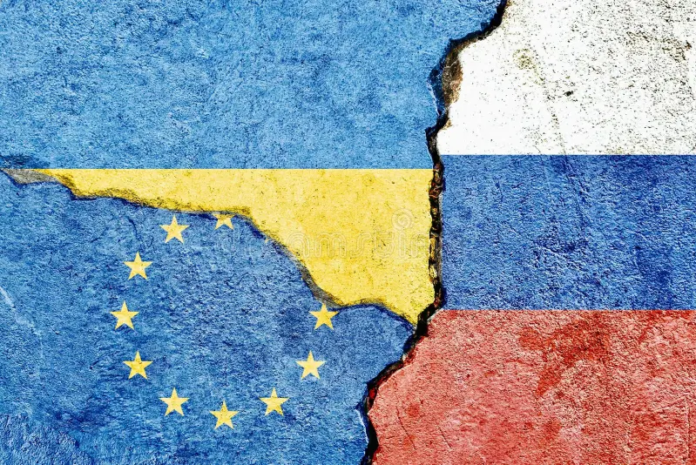
A recently published resolution shows Parliament’s requirements on a peace agreement between Russia and Ukraine. Its central standard, security guarantees equivalent to NATO Article 5, effectively rules out the softer political commitments that had been discussed on the months that followed.
The European Parliament adopted its resolution on the EU’s position regarding proposed peace plans for Ukraine on 27 November 2025, three weeks after the US presidential election had returned Donald Trump to office and renewed international speculation about possible settlement talks that could bypass the European allies. The resolution has just been officially published on 24 April, 2026, but it shows how the Commission was instructed to navigate the pushes to end the Ukraine war by the new tenant of the White House.
The resolution, published as C/2026/1719, reflects the consistent institutional position Parliament has maintained since the February 2022 invasion: that any peace arrangement must respect Ukraine’s sovereignty, its territorial integrity under international law, and its right to self-determination. It also adds a framework of specific conditions against which any proposed settlement would be assessed, and issues direct warnings about what Parliament considers unacceptable concessions.
The Acceptable Minimum
Parliament’s central demand is that any peace agreement must comply fully with the UN Charter, the Helsinki Final Act, and the relevant UN General Assembly resolutions affirming Ukraine’s territorial integrity. The resolution explicitly rejects any arrangement that would legitimise Russian territorial acquisition by force, including in the temporarily occupied territories of Donetsk, Luhansk, Zaporizhzhia, Kherson, and Crimea.
This Content Is For Members Only
This position has direct implications for the ceasefire-line question that any settlement negotiation would inevitably raise. Parliament does not endorse a ceasefire along current lines of control as a permanent political settlement, while acknowledging that a temporary ceasefire may be a necessary step toward a durable peace. The distinction between a military ceasefire and a political recognition of territorial changes is central to Parliament’s framing.
Security Guarantees
On the question of post-war security guarantees for Ukraine, seen as essential to prevent any settlement from simply providing Russia a pause to rearm, Parliament sets a demanding standard. The resolution states that security guarantees must provide protection equivalent to NATO Article 5 collective defence or, for EU members, Article 42(7) TEU mutual assistance. This effectively rules out any arrangement that offers softer or more conditional security commitments.
The equivalence standard is politically significant because it effectively means that any security guarantee framework acceptable to Parliament would require binding commitments from NATO and EU member states, not merely political declarations or non-binding assurances. The resolution calls on the Council and Commission to work toward a concrete legal security guarantee instrument as a complement to Ukraine’s ongoing NATO accession process.
Sanctions and Reparations
Parliament is unequivocal on sanctions, defending that they should not be lifted, suspended, or eroded until a peace agreement has entered into force and Russia has begun compliance with its obligations. The resolution opposes any goodwill gesture of sanctions relaxation in exchange for ceasefire commitments, citing the risk that such relaxation would reduce the pressure on Russia to comply with the peace terms.
On reparations, Parliament reaffirms its support for using the revenues from immobilised Russian sovereign assets, some 300 billion euros held primarily in Euroclear in Belgium, to finance reconstruction. The G7 already agreed to a 50 billion euro loan to Ukraine backed by these asset revenues in 2024; Parliament wanted this mechanism expanded and formalised as a reparations. This has so far been blocked, largely by Belgium, over doubts that if Russia were to initiate legal proceedings, Belgium would be legally obligated to restore these funds. However, were it to be included in peace negotiations, and accepted by Russia, this would be enough to prove consent and free Belgium from any legal liabilities.
No deal without Europe
Perhaps the resolution’s most pointed language concerns the negotiation format itself, as Parliament states that no agreement affecting European security, or the security of Ukraine, should be reached without the direct participation of the EU and European states. This is a direct response to the scenario, widely discussed in November 2025, in which bilateral US-Russia talks might yield an arrangement presented to European partners as a fait accompli.
Parliament calls on the Council and the High Representative to ensure that the EU has a seat at any formal negotiation table and that member states speak with a coordinated EU voice on peace terms. The resolution also stresses that Ukraine’s consent to any arrangement is non-negotiable: no third-party settlement can be imposed on Ukraine without its agreement.
