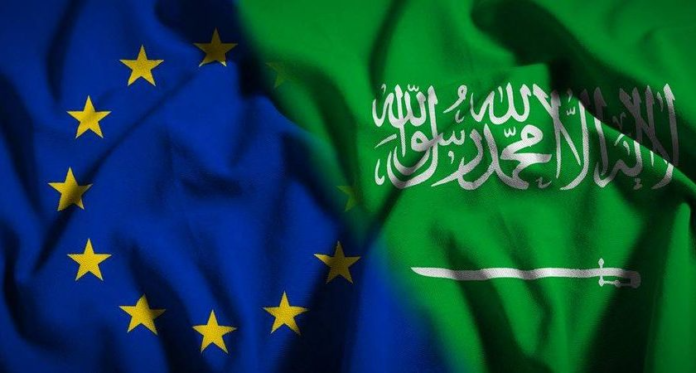
A resolution adopted on 16 December 2025 and now published maps Parliament’s expectations for the Strategic Partnership Agreement under negotiation since July 2025, from energy and IMEC connectivity to a specific call for a moratorium on executions, which reached 345 in 2024, an unprecedented figure
The Council authorised the opening of SPA negotiations with Saudi Arabia in July 2025, following the October 2024 EU-GCC summit. Saudi Arabia is the EU’s 17th-largest trading partner globally; the EU is Saudi Arabia’s largest foreign investor. The resolution welcomes the SPA process but conditions Parliament’s eventual consent on progress across several specific dimensions.
On energy and connectivity, the resolution identifies two strategic priorities. First, Saudi Arabia’s renewable energy potential: Saudi Arabia now ranks among the world’s top 10 energy storage markets and has pledged to produce 50% of its electricity from renewable sources by 2030 and 4 million tonnes of clean hydrogen annually. The resolution calls for joint EU-Saudi initiatives in green hydrogen, sustainable fuels, and next-generation energy infrastructure. Second, the India-Middle East-Europe Economic Corridor (IMEC), the connectivity project linking Asia to Europe via the Arabian peninsula, is explicitly endorsed, with calls to address its financing gap through EU, US, and Gulf investment.
On human rights, Parliament adopts a notably detailed position. It calls for a moratorium on executions, noting that Saudi Arabia carried out more than 345 executions in 2024 and condemns the continued use of the death penalty for non-lethal offences including drug-related crimes, and the fact that over half of 2025 executions to date have been of foreign nationals following trials that failed to meet international fair trial standards. The resolution also calls for the decriminalisation of same-sex sexual activity and for the release of all persons detained for the peaceful exercise of human rights, specifically referencing the Sakharov Prize awarded to Raif Badawi in 2015.
On social reform, the resolution acknowledges genuine progress: female labour force participation has more than doubled since 2017 to 36%; women now own 45% of SMEs and 17% of all enterprises; youth unemployment has fallen from 35% in 2006 to 16% in 2023. Concerns persist over the Personal Status Law and inequality in divorce, custody, and inheritance. The resolution also calls on Saudi Arabia to ensure the full implementation of the 2025 abolition of the Kafala system and to guarantee workers’ rights to strike and collective bargaining, particularly relevant given EXPO 2030 and the 2034 FIFA World Cup.
On geopolitics, the resolution commends Saudi Arabia’s role as mediator — in hosting Ukraine ceasefire talks, facilitating Yemen de-escalation, and contributing to Syrian reconstruction. Parliament urges Saudi Arabia to support EU sanctions against Russia and take measures against the Russian shadow fleet. Separately, it calls on Saudi Arabia to use its relationship with Türkiye to pressure Ankara into recognising Hamas as a terrorist organisation. The resolution also takes note of Saudi Arabia’s USD 600 billion commitment to invest in the United States, including a defence agreement, noting its implications for EU-Saudi defence industrial cooperation.
