
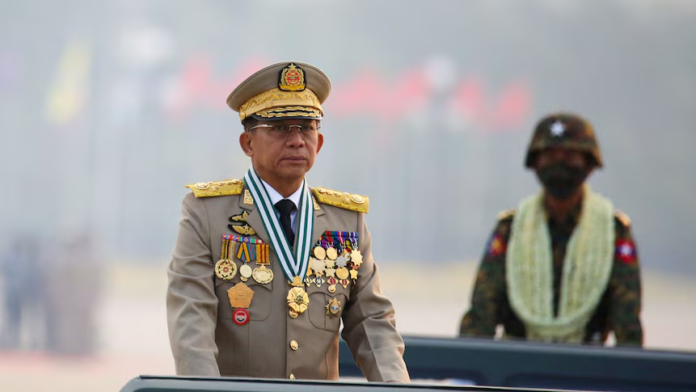
The EU extends its Myanmar restrictive measures regime until April 2027, amending 33 individual listings and 9 entity entries to reflect the junta’s institutional overhaul, and the new civilian mask its leader has put on since swearing in as president on April 10th
The Council of the EU extended and updated the sanctions regime it first adopted against Myanmar in April 2013, renewing it until 30 April 2027 and amending the entries of 33 individuals and nine entities in the consolidated list. One entry, a deceased person, has been deleted. The package arrives less than three weeks after Min Aung Hlaing, the architect of Myanmar’s February 2021 coup, was sworn in as the country’s president on 10 April, having stepped out of his military uniform to satisfy constitutional requirements few observers were fooled by.
The measures are published as two companion instruments, Council Decision (CFSP) 2026/927 and Council Implementing Regulation (EU) 2026/926, and will enter into force the day after publication. They are inseparable as a legal and political matter, as the Decision sets the political framework under the Common Foreign and Security Policy, while the Implementing Regulation gives it direct legal effect across Member States.
This Content Is For Members Only
A Coup in Civilian Clothing
The Myanmar sanctions regime was established in April 2013 and remained relatively dormant until the Tatmadaw’s seizure of power on 1 February 2021, when it was rapidly expanded to cover the military leadership and their economic networks. Since then, the EU has steadily deepened the list, adding military commanders, junta-aligned ministers, crony conglomerates, and figures involved in the junta’s propaganda and security apparatus.
The structural change reflected most prominently in today’s listings is the dissolution of the State Administration Council (SAC) on 31 July 2025 and its replacement by the State Security and Peace Commission (SSPC). The SAC was the formal name of the military governing body established in the immediate aftermath of the coup. The SSPC is its successor under the quasi-civilian framework the junta constructed to legitimise the sham elections held in December 2025 and January 2026. Most of the entries amended today reflect this institutional rebrand, with titles updated, roles clarified, and the ongoing designation reasons restated.
The updated entry for Min Aung Hlaing (entry 15, listed since 22 March 2021) now describes him as Chairman of the SSPC. He stepped down formally as Commander-in-Chief of the Tatmadaw weeks before the elections, positioning himself to take the presidency through a parliament his own military-backed party, the Union Solidarity and Development Party, controls. The USDP secured 232 of 263 seats in the lower house and 109 of the 157 seats announced in the upper chamber, in an election that was rejected by ASEAN, condemned by human rights organisations, and from which major population centres and conflict zones were excluded.
The EU’s listing reasons for Min Aung Hlaing are that he staged the coup, concentrated power in his own hands, oversaw killings of civilian protesters, and bears direct responsibility for crimes against the Rohingya population dating back to 2017. The International Criminal Court prosecutor requested an arrest warrant for him in November 2024 for alleged crimes against humanity relating to Rohingya deportation and persecution. ICC judges have not yet issued a public decision.
The New Prime Minister and the Fuel Chain
Among the amended entries, Nyo Saw (entry 100) is notable. Listed since December 2023, he became Prime Minister on 31 July 2025, when the SSPC replaced the SAC. His listing notes that he oversees a committee tasked with importing fuel from Russia, who happens to be Myanmar’s principal arms supplier, and chairs the military-owned conglomerate Myanmar Economic Corporation (MEC). He also sits on the Foreign Exchange Supervision Committee. The EU’s sanctions listings treat military command, economic capture, and external supply chains as a single sanctionable network.
Deputy Commander-in-Chief Soe Win (entry 17) and Dwe Aung Lin (entry 21), who served as SAC Secretary and now holds the equivalent role in the SSPC, are also updated to reflect the institutional transition. The pattern across the 33 amended individual entries is the same, with their roles being updated, SSPC membership noted, designation reasons restated and in some cases deepened to reflect continued conduct since earlier listing dates.
The nine other amended entity entries include Myanmar Economic Holdings Public Company Ltd (MEHL) and Myanmar Economic Corporation (MEC), the two military conglomerates that form the financial backbone of the Tatmadaw’s economic autonomy. Both generate revenue across banking, manufacturing, tourism, and resource extraction, with their boards composed exclusively of senior military officers.
An Extended Conflict
The renewal comes as the civil war engoulfing Myanmar stalls. Anti-junta forces, including the People’s Defence Force aligned with the National Unity Government and a range of ethnic armed organisations hold significant territory, particularly in border regions. The Arakan Army has also established effective control over most of Rakhine State. The resistance’s principal weakness remains coordination, as the various armed groups have frequently operated independently and, in some cases, at cross-purposes.
The Tatmadaw, meanwhile, has clawed back some lost ground with Chinese and Russian support, improved drone and air campaign tempo, and selective use of armed militias. Russia signed a military cooperation agreement with the junta in February 2026, while Iranian oil shipments, recently stopped by the US administration, sustain the junta’s air campaign. Over 96,000 people have been killed since the coup, according to ACLED estimates, with at least 3.6 million being internally displaced.
